Showing posts with label reflection. Show all posts
Showing posts with label reflection. Show all posts
Wednesday, May 6, 2020


Thursday, March 12, 2020
1922
Scanned and made a composite image of my favorite photograph in the library; 1922 Afton high school students labeled and keyed with their names. Wonderful surprise to find the hand-written names on the back. Zooming in on the faces and imagining their stories gives me chills.


Wednesday, March 4, 2020
This week's thread
The past few days I have been doing some digital grunt work; scanning a couple hundred pages (and assorted inserted documents) from the 1917-1934 Afton Board of Education minutes. It is a nicely disciplined task ... for posterity.

There is an enterprising stretch in there when an ACS building project added a gym, auditorium, and plumbing (1927), and then the consolidation of over a dozen one-room school house into the central school along with the purchase of the first fleet of four buses (1932). Difficult not to stop an read the entries while trying move through them.
Then last night, my brother links me to a video about the construction of Hoover Dam (1931-1936) where the word enterprising finds its ultimate example; the sheer vision, moxy, and brawn of American know-how and industry carving out an icon to modernity.
And I guess I'm wondering if Afton's own modest climb into the 1930s wasn't just another reflection of a country and a time coming into its own.
Wednesday, February 26, 2020
Speak Truth Plurally
On the heels of my previous post, I read an interview in the Chronicle of Higher Education with Scott L. Newstok which led me to his 2016 essay in that publication, "How to Think Like Shakespeare." He urges many of the rigors of the Renaissance (precision, inventiveness, and empathy) as a template for present-day habits of the mind: communication, collaboration, and creativity.
In explaining the complete meaning of rhetoric he writes:
His reasoning for the value of rhetoric:
In explaining the complete meaning of rhetoric he writes:
In the Renaissance, the rhetorical tradition encouraged such "play of the mind" through the practice of disputation. Students had to argue from multiple perspectives rather than dogmatically insist upon one biased position.I think that aligns pretty well with Chimamanda Adichie's avoiding the danger of only one story.
Once you are familiar with Shakespeare’s training in disputation, you can easily see how it would lead to the verbal give-and-take that constitutes the heart of drama. As Zadie Smith marvels: "Shakespeare sees always both sides of a thing. ... In his plays he is woman, man, black, white, believer, heretic, Catholic, Protestant, Jew, Muslim. ... He understood what fierce, singular certainty creates — and what it destroys. In response, he made himself ... speak truth plurally." Now that’s the kind of critical thinking you should aspire to: speaking truth plurally.
His reasoning for the value of rhetoric:
Antonio Gramsci described education in this way: "One has to inculcate certain habits of diligence, precision, poise (even physical poise), ability to concentrate on specific subjects, which cannot be acquired without the mechanical repetition of disciplined and methodical acts." You take it for granted that Olympic athletes and professional musicians must practice relentlessly to perfect their craft. Why should you expect the craft of thought to require anything less disciplined? Fierce attention to clear and precise writing is the essential tool for you to foster independent judgment. That is rhetoric.
Renaissance rhetoric achieved precision through a practice that might surprise you: imitation. Like "rhetoric," "imitation" sounds pejorative today: a fake, a knockoff, a mere copy. But Renaissance thinkers — aptly, looking back to the Roman Seneca, who himself looked back to the Greeks — compared the process of imitation to a bee’s gathering nectar from many flowers and then transforming it into honey. As Michel de Montaigne put it:
"The bees steal from this flower and that, but afterward turn their pilferings into honey, which is their own. ... So the pupil will transform and fuse together the passages that he borrows from others, to make of them something entirely his own; that is to say, his own judgment. His education, his labor, and his study have no other aim but to form this."
Monday, February 24, 2020
The Danger of a Single Story
Even though I am well past the 21-millionth person to watch Chimamanda Adichie speak in this video, it arrives for me just in time; as I imagine it did for them.
Wednesday, February 12, 2020
Sharing experience and having it valued

I enjoyed a swell visit today from both the Principal and Dean of Students at Walton Central School as well as the DCMO ISS STEM Coordinator. They are considering creating a MakerSpace and they came to pick my brain about our library's experience with that kind of thing. As always, it's wonderful to exchange ideas with colleagues who have experience in the trenches and are open-minded and appreciative.
Thursday, February 6, 2020
Checking out a Human Book
The February issue of School Library Journal features an article entitled, "Unjudging a Book." It describes programs at several schools and libraries that have adopted the Human Library model to foster respect and reduce bias by "checking out" a "human" book. It is an idea that may be within reach for our school.

Our Guidance department recently planned and carried out a very successful Career Day at school. Professionals from diverse paths, many with a connection to our staff, were contacted, vetted, and scheduled for four morning sessions with mixed grade-level students to share and discuss their career.
Our school has also invested in the PBIS program and adopted a day-end period for connecting with a mixed-grade circle of students each day to cultivate connectedness and trust. We "circle up" and use a "talking piece" to practice nonjudgmental interaction.
We seem to have the organizational experience as well as the small group systems in place to tackle this equally important focus at ACS; fostering respect and reducing bias. We seem like such a good fit for the challenge; both in our district focus on those issues and our limited encounter with the diverse kind of lives that make up the world.
I like very much the whole idea of getting real, walking about in someone else's shoes, and challenging stereotypes by engaging "primary sources."
Friday, December 20, 2019
Best foot forward
Provided the setup/infrastructure for the annual recent-alumni/senior-class convocation. The over-riding message was " you need to be an advocate for yourself." Good tip for everyone.


Thursday, December 12, 2019
Planning your next move
Chess is one of the cornerstones of the middle school experience in this library. It seems they all play. I believe it is a constructive use of time; cultivating their faculties of visualization, planning, reflection, resilience.
This recent Vimeo video of elementary students reflecting on the benefits of chess says it all:
The Magic of Chess from Jenny Schweitzer Bell on Vimeo.
This recent Vimeo video of elementary students reflecting on the benefits of chess says it all:
The Magic of Chess from Jenny Schweitzer Bell on Vimeo.
Tuesday, November 26, 2019
Pages to PDF

Thursday, November 21, 2019
Allowing each other to contribute
Doing some project-brainstorming with my Period E class; can we build on a suggestion? can we visualize tasks, possibilities, outcomes? who might be a resource, stakeholder? who are we teaching with our research? what will me make to demonstrate what we are learning: videos, flash cards, exhibits, games, mock-ups, events?
And, importantly, do I sense a willingness and enthusiasm to embrace this opportunity as their own?

And, importantly, do I sense a willingness and enthusiasm to embrace this opportunity as their own?

Wednesday, November 20, 2019
Post-poetry glow
Many thanks to the friends, colleagues, and students who came to our library Coffee House last night and were such comforting listeners as I read a selection of my poetry. It was good to be among their warm company and to share so many diverse conversations about the community, books, and history.Looking forward to the next Coffee House in february.
Thursday, November 7, 2019
Extending the message
We have so many good ideas and lessons on character education and such, but always the challenge of keeping them before the awareness of our students. So I usually try to extend the message, at least a day or two.
Yesterday our PBIS group did an exercise where we matched up word-cards (honesty, loyalty, compassion, ...) with people that we knew, and then talked about how they exemplified those attributes, and whether we had ever told them how much that meant to us.
So this morning I taped those same cards along with that question on my library/lobby door, as well as taping a word to each of the gym overlook-windows; just a little visual-jog to connect yesterday to today ... and maybe to tomorrow.


Wednesday, October 30, 2019
Book talk about a book talk

I was reading this recent book review in the New York Times; Lakota America by Pekka Hamalainen. The reviewer, Parul Sehgal, pointed out two characteristics of the book which intrigue me and draw me in as a reader of histories:
The challenge of writing this history, Hamalainen notes, was making iconic events and figures unfamiliar again, which is never more necessary than at the twilight of the Lakota empire.I like that idea; making the iconic events unfamiliar so that we have the chance to reorient our perspective; becoming more open, hopefully to new ideas. And then this other:
In retrospect, history often seems preordained; vulnerabilities seem garishly announced, outcomes a matter of course. Hamalainen seeks…to infuse a sense of chance and contingency in the narrative, to remain “alive to the ever-present possibility that events could have turned out differently.” He sows this feeling of uncertainty into the composition of the book, replacing a traditional arc with “a more unpredictable narrative structure that is full of triumphs, twists, reversals, victories, lulls and low points, big and small. If the book’s Lakotas — haughty and imperial at one moment, fearful and vulnerable the next, prudent and accommodating the third — seem strange and unfamiliar, this portrayal has succeeded.Chance and contingency frame so much of our lives, it seems entirely appropriate and strategic to frame a history the same way.
Gotta get me this book.
Thursday, October 24, 2019
Who you were
Not for the first time this ACS autograph book from the the 1940s brought me to a halt as I was looking for something else in our cabinet of archive material.
Who you were
Buried in the library
for at least my 27 years
these lists of who you were
have remained unaged and elegant
within the sombre black
of memories unknown.
Being only names
I search for rationale -
why keep you in the archive?
what can your names tell me
other than where you were
on this occasion, on this date -
mothers and dads
witnessing, indelibly, your children's lives?
And then I think
how like cemetery stones
your signatures have become -
gracefully inscribed, alone,
with only your long wait
to join you to each other
who were neighbors once,
perhaps neighbors still.
10/23/19
Monday, October 21, 2019

Tuesday, October 15, 2019
From reading
Every couple of months, my wife's friend gives us a small pile of New Yorker magazines. They make a fine nice night's browsing and reading; cartoons, poems, book reviews, articles.
A few weeks ago, I was going through a recent stack and read a poem by an author I did not know. The poem was, Claude Monet, "The Artist's Garden at Vetheuil, 1880", by Ciaran Carson. I really liked it. In fact, I hopped on Thriftbooks and ordered two of his books, blindly.
I have been reading his prose book, Fishing for Amber; alternating essay/chapters of pub myths and Annie Dillard-like esoteric dives into nuggets of the world. Frankly, I have been skipping the pub stories and deeply enjoying, and quoting, the others - all of them loosely connected like Nabakov coincidences.
So he's writing at length about marigolds, Genus calendula in Latin: colors, medicinal properties, etc. And that word, the sound of it, rings a bell. It was my Aunt Clara's "real" name, her Italian name, Calendula. So she was Marigold. Which, poignantly, was the affectionate name my caretaker/brother called my Mom, Marijane, when they were joshing - Marigold.
And then yesterday in the Sunday New York Times an obituary for Ciaran Carson. Of course, his words and books remain, but there is something of the passing serendipitous stranger in this (perhaps one you might meet in a pub), one who you meet once, but who somehow touches you deeply, changes you in an intimate way.
And so, I keep reading.
Tuesday, September 24, 2019
Booktalk

I don’t know about you, but I expect, at least occasionally, to gain some insights into my world; either through people I meet, experiences I have, or by allowing myself time for reflection.
For me, all three can happen when I read a book. Sometimes it happens when I read two in a row that I thought had nothing to do with each other. That happened this Summer.
After 40 years, I re-read Annie Dillard’s Pilgrim at Tinker Creek. It is a book my wife shared with my soon after we were married and it hit me like few others have. Not only is it gorgeously written, and intellectually rich, but the author’s curiosity and profound awakening to what was miraculously transpiring in the natural world at her feet inspired my life-long awareness of the incremental and particular world that is mine - right here in Afton, even.
It was her wonderment at the unimaginable inventiveness, immense complexity, and sheer fecundity of nature’s engine at work that awed her and transformed me.

Transformed me.
After re-reading that, I turned to a bucket-list book; Ovid’s The Metamorphoses - written 2000 years ago ( I have enduring weak spot for reading “first stories.’) It is a series of linked story/myths rooted in the appetites, foibles, and indifference of the gods as they muck around with human lives and their own eternal ones transforming, through confrontations and kindnesses, the world into its myriad varieties. The metamorphoses.
Like Pilgrim at Tinker Creek, it is rich with the serendipitous, unbelievable, and often heartless “change” that is our world. Not only seeking to “explain” how that variety came to be (mostly through vengeful wrath) , but by sobering us to how unplanned, accidental, and out-of-our-hands this tumultuous but beautiful life of ours is.
Two writers. Two eras. Both trying to get a handle on why beauty and purpose emerge in a world that seems both indifferent and incidental, yet persistently dear and our own.
Monday, September 23, 2019
What the poets know
This article in the NYT takes a look at the earning of STEM majors versus Liberal Arts majors over time. It states that out of the gate STEM students earn more, but that by the 40-year mark, LA students show faster growth; nearly matching or surpassing computer and engineering majors. This is attributed to the Liberal Arts fostering "soft skills" like problem-solving, written communication, critical thinking, and the ability to work in a team; which have long-run value as workers move into higher-paying management and administrative roles.
This is an important perspective to keep in mind as we sometimes leap at the latest teaching/learning trend that appears to pipeline our students to "success."
This is an important perspective to keep in mind as we sometimes leap at the latest teaching/learning trend that appears to pipeline our students to "success."
Monday, September 9, 2019
Spreading the word(s)
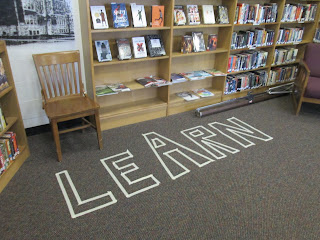
My PBIS group really got into during our 20-minute end-of-the-day session. They worked in spontaneous small teams to tape some meaningful words to the library floor for all students to reflect on. We think it should be as easy to act on these words as it was to slap them on the floor!




Subscribe to:
Posts (Atom)

