Showing posts with label communication.. Show all posts

Tuesday, March 10, 2020

Mural mock-ups


Came across a couple folders with many of the silhouettes and research notes from our 2009 Wildlife Hallway project. Put them up on the bulletin board for another moment in the sun. #proud


Wednesday, February 26, 2020

Speak Truth Plurally

On the heels of my previous post, I read an interview in the Chronicle of Higher Education with Scott L. Newstok which led me to his 2016 essay in that publication, "How to Think Like Shakespeare." He urges many of the rigors of the Renaissance (precision, inventiveness, and empathy) as a template for present-day habits of the mind: communication, collaboration, and creativity.

In explaining the complete meaning of rhetoric he writes:

In the Renaissance, the rhetorical tradition encouraged such "play of the mind" through the practice of disputation. Students had to argue from multiple perspectives rather than dogmatically insist upon one biased position.
Once you are familiar with Shakespeare’s training in disputation, you can easily see how it would lead to the verbal give-and-take that constitutes the heart of drama. As Zadie Smith marvels: "Shakespeare sees always both sides of a thing. ... In his plays he is woman, man, black, white, believer, heretic, Catholic, Protestant, Jew, Muslim. ... He understood what fierce, singular certainty creates — and what it destroys. In response, he made himself ... speak truth plurally." Now that’s the kind of critical thinking you should aspire to: speaking truth plurally.
I think that aligns pretty well with Chimamanda Adichie's avoiding the danger of only one story.

His reasoning for the value of rhetoric:
Antonio Gramsci described education in this way: "One has to inculcate certain habits of diligence, precision, poise (even physical poise), ability to concentrate on specific subjects, which cannot be acquired without the mechanical repetition of disciplined and methodical acts." You take it for granted that Olympic athletes and professional musicians must practice relentlessly to perfect their craft. Why should you expect the craft of thought to require anything less disciplined? Fierce attention to clear and precise writing is the essential tool for you to foster independent judgment. That is rhetoric.


Renaissance rhetoric achieved precision through a practice that might surprise you: imitation. Like "rhetoric," "imitation" sounds pejorative today: a fake, a knockoff, a mere copy. But Renaissance thinkers — aptly, looking back to the Roman Seneca, who himself looked back to the Greeks — compared the process of imitation to a bee’s gathering nectar from many flowers and then transforming it into honey. As Michel de Montaigne put it:
"The bees steal from this flower and that, but afterward turn their pilferings into honey, which is their own. ... So the pupil will transform and fuse together the passages that he borrows from others, to make of them something entirely his own; that is to say, his own judgment. His education, his labor, and his study have no other aim but to form this."

Monday, January 27, 2020

Drawing with Pencils: Live!

Made my live presentation to 4th graders today about how artists use pencils. Had a blast! Very respectful class and so willing to ask questions and share ideas. Here is my prep video.

Wednesday, January 15, 2020

First-time video

A student introduction to creating a video began with staging a variety of about 20 assorted shots without a story line. The student then created a "story" from the pool of available takes. As a final version, he labeled the type of camera shots; establishing his knowledge of these building blocks and their usefulness.


To view this video please enable JavaScript, and consider upgrading to a web browser that supports HTML5 video

Subsequently, he has created a voice-over video based on a very structured script about kitchen safety. In this project, the challenge was quality control and attention to detail; not fun, but a useful rehearsal for the expectation of any job.


Featured Readers: Design

Our Elementary Librarian asked if I would work up a design for her "Featured Reader" incentive program. The series of wall posters will have a "book" format. Here's the cover and introduction. The reader pages will feature a student photo on the left and their accomplishment on the right.

Thursday, November 21, 2019

Allowing each other to contribute

Doing some project-brainstorming with my Period E class; can we build on a suggestion? can we visualize tasks, possibilities, outcomes? who might be a resource, stakeholder? who are we teaching with our research? what will me make to demonstrate what we are learning: videos, flash cards, exhibits, games, mock-ups, events?

And, importantly, do I sense a willingness and enthusiasm to embrace this opportunity as their own?


Thursday, November 7, 2019

Extending the message

We have so many good ideas and lessons on character education and such, but always the challenge of keeping them before the awareness of our students. So I usually try to extend the message, at least a day or two.

Yesterday our PBIS group did an exercise where we matched up word-cards (honesty, loyalty, compassion, ...) with people that we knew, and then talked about how they exemplified those attributes, and whether we had ever told them how much that meant to us.

So this morning I taped those same cards along with that question on my library/lobby door, as well as taping a word to each of the gym overlook-windows; just a little visual-jog to connect yesterday to today ... and maybe to tomorrow.


Wednesday, November 6, 2019

Monday, September 23, 2019

Reacting to the Past

I was led to this site by an article in the Chronicle of Higher Education. "Reacting" is a role-playing curriculum at the college level to promote engagement with big ideas, employ collaborative skills, and inhabit the historical moment in all its context. Although it might not fly at the HS level, the idea of immersing students in the dynamics of an historical moment by having them be historical characters in it sounds awfully good. Perhaps a good PD visit for one of our staff.

What the poets know

This article in the NYT takes a look at the earning of STEM majors versus Liberal Arts majors over time. It states that out of the gate STEM students earn more, but that by the 40-year mark,  LA students show faster growth; nearly matching or surpassing computer and engineering majors. This is attributed to the Liberal Arts fostering "soft skills" like problem-solving, written communication, critical thinking, and the ability to work in a team; which have long-run value as workers move into higher-paying management and administrative roles.

This is an important perspective to keep in mind as we sometimes leap at the latest teaching/learning trend that appears to pipeline our students to "success."

Thursday, September 19, 2019

Leveraging rocks

The identity rocks that our K-12 painted together are looking great at the school entrance.
I made a composite David Hockney-esque long poster from their image and am using it to support some school initiatives; like attendance.

Installed outside the Elementary Office!
Cutting out a bunch of individual rock messages to post also.

Wednesday, September 18, 2019

Math challenge

Can I find a way to "display" math? Going to try some end-cap questions.

Friday, September 13, 2019

Rockin' the Garden

Going to try to extend the lesson of our school-wide rock-painting experience by incorporating them into some hallway posters.

Monday, September 9, 2019

Spreading the word(s)

My PBIS group really got into during our 20-minute end-of-the-day session. They worked in spontaneous small teams to tape some meaningful words to the library floor for all students to reflect on. We think it should be as easy to act on these words as it was to slap them on the floor!


Thursday, June 6, 2019

Emailed this to colleagues

    Load Up with books for the Summer:
     a reason for faculty participation

            My guess is that you are a life-long learner - just like we expect our students to be. I also guess that you continually challenge yourself, within your discipline and without, with reading widely and deeply - especially during the Summer when short-term freedom from routine and long-term guilt over reading-procrastination is ripest.

    So along with the Summer books that you intend to buy or borrow or download from your usual sources, I invite you to borrow or download some from the MS/HS Library. Whether you are delightfully surprised or disappointed-as-expected by our holdings, it would be a powerful incentive to our students next Fall when you casually mention in a class discussion having “read something about that this Summer from a book I borrowed from the ACS Library. You should check it out, too.”

    Although you and I may be day-in/day-out near-strangers, I am, like all librarians everywhere, delighted and non-judgmental when a new face appears to borrow a book. Whether it’s a bucket-list classic, a binge-read of a favorite series, sci-fi or science essays, historical perspectives in fiction or in fact, new Young Adult fiction to help you better inhabit the teenage experiences of gender issues, multi-culturalism, and family problems, or titles for your own children to enjoy…the MS/HS Library has something for you.

    I would be glad to curate a list of books for you to choose from based on your interests, or, by all means, stop by to browse the table-top displays in the library foyer or explore the stacks.

    Being explicit about the fact that we read on our own for meaning and for recreation is part of “walking the walk” as we raise that expectation for our students. Being seen in the MS/Library, or letting it be known that you are reading a book or ebook from our collection is a concrete way to mentor that life-long discipline.

    Thanks for your help,


Wednesday, May 29, 2019

Leveraging technology

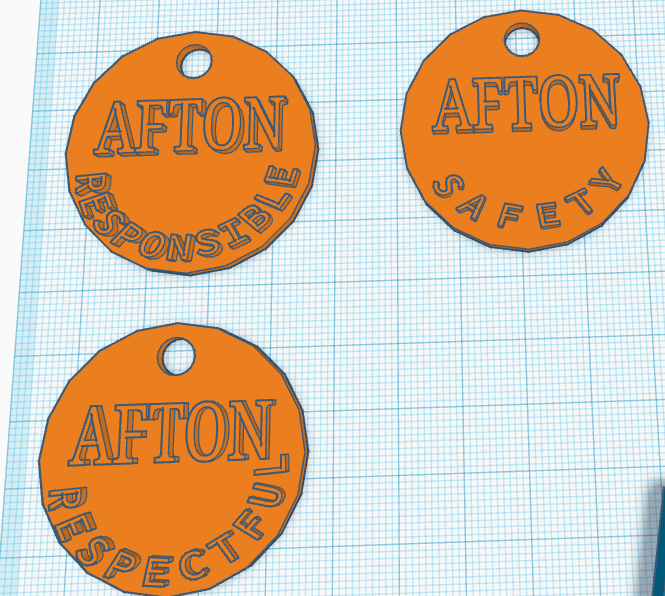
We have been learning how to leverage technology while designing in Tinkercad.
Students have been using app functions like Duplicate/Group/Ungroup, to make iterations of designs we have critiqued; learning not to settle for the first idea when the program allows modifications so easily. Importantly, we keep ALL the designs so that we can see the decisions and alternatives we have tried.
Our daily routine also involves learning to take and file screen capture images, exporting STL files, and sharing these with me as email attachments (just as you would with a co-worker across the country); using a suite of tools to create, explain, and share their work.
Our analysis of work includes functionality, attention to detail, and further possibilities. For instance moving from lower-case to upper-case letters for legibility.
Practicing the process of what tech tools can do, using them in concert with each other, and sharing ideas with them have been as important as the actual printed product. We have been working on and assessing the skills of "getting there",  not just on the destination.
BTW, the project we decided on was to design medallions for our school's Crimson Crest recognition program.


Monday, April 8, 2019

It's our world

I configured another tri-panel display for the school lobby. This one consists of research and posters that I made about the Bumps Creek which flows through our school grounds.
It is a display about the environment, about (by example) how one might "present" project findings, about the expectation of student work we might display, and a sideways call to put virtual devices aside a moment to be humbled by the world around us.

Tuesday, April 2, 2019

Poetry Rules in April

Along with sending off poetry-reading videos to ELA staff to share, I have put together some poetry displays in the library foyer.