Showing posts with label critical thinking. Show all posts

Wednesday, January 15, 2020

First-time video

A student introduction to creating a video began with staging a variety of about 20 assorted shots without a story line. The student then created a "story" from the pool of available takes. As a final version, he labeled the type of camera shots; establishing his knowledge of these building blocks and their usefulness.


To view this video please enable JavaScript, and consider upgrading to a web browser that supports HTML5 video

Subsequently, he has created a voice-over video based on a very structured script about kitchen safety. In this project, the challenge was quality control and attention to detail; not fun, but a useful rehearsal for the expectation of any job.


Thursday, December 12, 2019

Planning your next move

Chess is one of the cornerstones of the middle school experience in this library. It seems they all play. I believe it is a constructive use of time; cultivating their faculties of visualization, planning, reflection, resilience.
This recent Vimeo video of elementary students reflecting on the benefits of chess says it all:

The Magic of Chess from Jenny Schweitzer Bell on Vimeo.

Thursday, October 31, 2019

Geo-based bulleting board

A Bierstadt and Cole landscape (each garnished with a Google Earth image)  headline our conversation about U.S. geography.

Monday, September 23, 2019

Reacting to the Past

I was led to this site by an article in the Chronicle of Higher Education. "Reacting" is a role-playing curriculum at the college level to promote engagement with big ideas, employ collaborative skills, and inhabit the historical moment in all its context. Although it might not fly at the HS level, the idea of immersing students in the dynamics of an historical moment by having them be historical characters in it sounds awfully good. Perhaps a good PD visit for one of our staff.

What the poets know

This article in the NYT takes a look at the earning of STEM majors versus Liberal Arts majors over time. It states that out of the gate STEM students earn more, but that by the 40-year mark,  LA students show faster growth; nearly matching or surpassing computer and engineering majors. This is attributed to the Liberal Arts fostering "soft skills" like problem-solving, written communication, critical thinking, and the ability to work in a team; which have long-run value as workers move into higher-paying management and administrative roles.

This is an important perspective to keep in mind as we sometimes leap at the latest teaching/learning trend that appears to pipeline our students to "success."

Friday, June 21, 2019

2002 Library Project: Afton Volunteers

Took a walk down memory lane today; watched our 2002 video documentation of our 10-week Art/Library project. In many ways, I think those 10-week project anticipated very closely the type of skills-based learning opportunities we look to create today.

(This was the opening ice-breaker team-building bridge-building session to get the  juices flowing)


Tuesday, June 11, 2019

Filling in the gaps

The NYRB is always such a wealth of diverse and wonderfully esoteric scholarship. And often it supplements or unseats an understanding I need to modify or discard.

An example is Howard French’s review of several books about the African Middle Ages. His thesis sentence sets the tone:
‘It may remain a little-known fact, but Africa has never lacked civilizations, nor has it ever been as cut off from world events as it has been routinely portrayed. Some remarkable new books make this case in scholarly but accessible terms, and they admirably complicate our understanding of Africa’s past and present.”
In the course of his discussion, he introduces the fabulously wealthy Malian ruler Mansa Musa who in the early 14th century journeyed to Mecca by way of Cairo with “13 to 18 tons” of pure gold and thousands of slaves and attendants. Beyond the legends of this entourage, it is the fact that only a few years later (1375) he earned an illustrated spot on the Catalan Atlas, spurring fortune-seekers and ultimately the competition of the slave trade between Portugal and Spain which “ was crucial to the creation of the modern nation-state and of what became modern European nationalism;” certainly a supplement to my understanding of that phenomenon.

He also highlights the observation of Herman L. Bennett “that the Sahara has long been miscast as a barrier separating a notional black Africa from an equally notional white or Arab one. In reality, it argues, the desert has always been not just permeable but heavily trafficked, much like the ocean, with trade as well as religious and cultural influences traveling back and forth, and with world-shaping effects.” Discard and update.

Reading the NYRB is a little more intense than browsing a magazine. I find myself underlining text, looking up books and references to research, and adding snippets to this bog so that I will remember how and when my understanding of the world changed and grew.

Friday, June 7, 2019

Sound bite for Danny D.

So I got my sound bite in 3D Printing: An Introduction by Stephanie Torta (full disclosure: Stephanie is the daughter of one of our ACS teachers; hence, my invitation to participate!)

I am proud of what I said in the interview because I believe every word of it.

Thanks again to all the Tortas for the opportunity.


Wednesday, May 29, 2019

Leveraging technology

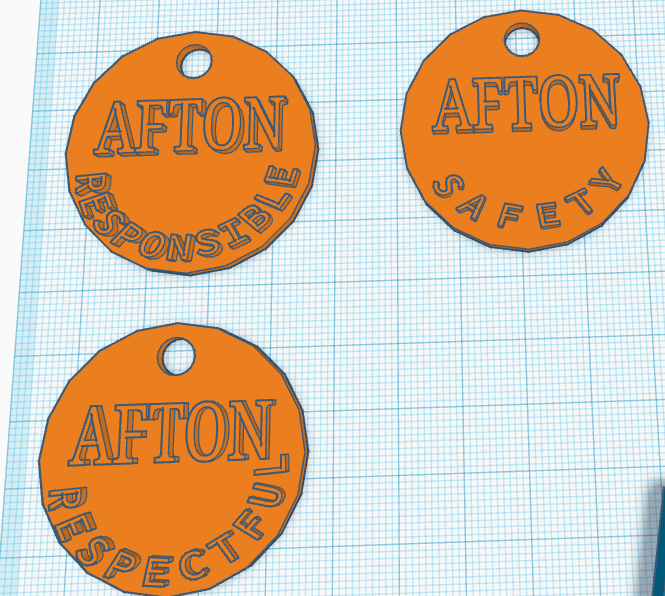
We have been learning how to leverage technology while designing in Tinkercad.
Students have been using app functions like Duplicate/Group/Ungroup, to make iterations of designs we have critiqued; learning not to settle for the first idea when the program allows modifications so easily. Importantly, we keep ALL the designs so that we can see the decisions and alternatives we have tried.
Our daily routine also involves learning to take and file screen capture images, exporting STL files, and sharing these with me as email attachments (just as you would with a co-worker across the country); using a suite of tools to create, explain, and share their work.
Our analysis of work includes functionality, attention to detail, and further possibilities. For instance moving from lower-case to upper-case letters for legibility.
Practicing the process of what tech tools can do, using them in concert with each other, and sharing ideas with them have been as important as the actual printed product. We have been working on and assessing the skills of "getting there",  not just on the destination.
BTW, the project we decided on was to design medallions for our school's Crimson Crest recognition program.


Monday, March 4, 2019

Friday, October 19, 2018

The Printed Word

I enjoyed this long cover article in Harper's magazine (print), The Printed Word in Peril by Will Self. I did lots of underlining of choice paragraphs, shrewd insights, well-turned aphorisms, and several observations that he does a much better job of stating than I do. Much of what he says resonates to me as a reader, a librarian, and as a human mindful of, but not crazy about, the march of change.

I do believe his closing paragraphs to be sincere little surprises for him, as when he writes:
It was only when finishing this essay that I fully admitted to myself what I’d done: created yet another text that’s an analysis of our emerging ­BDDM life but that paradoxically requires the most sophisticated pre-BDDM reading skills to fully appreciate it. It’s the same feeling—albeit in diminuendo—as the one I had when I completed the trilogy of novels I’ve been working on for the past eight years, books that attempt to put down on paper what it feels like for human minds to become technologically transformed. I felt like one of those Daffy Ducks who runs full tilt over the edge of a precipice, then hovers for a few seconds in midair (while realization catches up with him), before plummeting to certain death. Look down and you may just see the hole I made when I hit the ground.
*"I referred above to “bidirectional digital media,” by which I mean 
the suite of technologies that comprises the wireless-connected 
computer, handheld or otherwise, the World Wide Web, and the internet. 
Henceforth I’ll abbreviate this term to BDDM."

Friday, June 1, 2018

The reading-making connection

After seven great days of sustained reading in the library, these 7th graders are beginning their interpretive projects about their novels. The ACSLIB has been steaming laboratory of creativity and problems-solving!

Friday, May 11, 2018

Tops

These two students teamed up to investigate Tinkercad together. They configured a top design. Adding supports worked pretty good on the print job. They see that they have several modifications to make.


Wednesday, April 25, 2018

Hard right rudder

One week into constructing a fan-powered boat in the MakerSpace we decide we needed a rudder. Used the opportunity to demonstrate Tinkercad and the 3D printer. We analyzed the resulting piece and the team decided it need to be larger to accommodate other components.

Wednesday, February 21, 2018

It was an analog world

I'm working my way towards an inter-active "analog" exhibit. Post-introducing students to the way technology matched up to research and information-sharing before the 4G and Cloud age; their age.
I will have the same images available on a carousel of 35 mm slides as on the digital flat screen TV opposite; plus the cameras used to capture the images.
I am closing in on replacement bulbs for my Minolta RP503 (EHJ) microfilm viewer/printer and my Bell & Howell ABR-VIII (DDS) microfiche reader. Hope to have students looking up New York Times and Time articles, and then finding them on the readers ... completing an ILL photocopy request form (remember those!).
Many of these machines (appliances?) have been in deep storage here at ACS. It is as though I am exhibiting skeleton; the students are full of questions and want to USE them!


Tuesday, January 30, 2018

Prior knowledge

Made a poster linking some observations from a recent book I read (Tarawa: The Story of a Battle)to our home town.

Tuesday, January 23, 2018

Libraries as Academic Innovation Centers


     Every time I read “academic innovation center” (AIC) in this article from the Chronicle of Higher Education, I saw “librarian.” While the piece discusses the role of AICs at the college level, the problems they seek to solve, the technology and instructional innovation they cultivate, and the collaboration that is their hallmark, seems a role for librarians at our level to assume, if they don’t already.

      An AIC (at least the one reviewed at Michigan State) “blends interdepartmental collaboration, academic technology, and new forms of pedagogy” to analyze instructional practice and design improved ones. It is not necessarily supposed to lead change, but to be the catalyst. It is in the business of convening stakeholders, encouraging open-minded proposals rooted in scholarship, and most importantly being a real agent for helping to improve student engagement and success.

      As I think of our district; the number of students on academic support and the degree of their classroom engagement, the idea of an in-house AIC with a librarian as the hub, holds out the promise of being a workable vehicle, however modest, to broker the expectations of administration, the frustrations of teachers, and the possibilities of instructional design.

    Perhaps no other professional on staff is better positioned to integrate collaboration, instruction, technology, and innovation than the school librarian. Plus, I think we are viewed/respected as being not exclusively allied with any of those factions; giving us agency to facilitate discussion, expect professionalism, and represent the high road to student opportunity.

Thursday, December 14, 2017

December Library Foyer Questions

If you'd like to take a go at it yourself, here's a recent ACS budget as well as the one from 1941:

 and