Showing posts with label Environment. Show all posts

Tuesday, March 10, 2020

Mural mock-ups


Came across a couple folders with many of the silhouettes and research notes from our 2009 Wildlife Hallway project. Put them up on the bulletin board for another moment in the sun. #proud


Monday, April 8, 2019

It's our world

I configured another tri-panel display for the school lobby. This one consists of research and posters that I made about the Bumps Creek which flows through our school grounds.
It is a display about the environment, about (by example) how one might "present" project findings, about the expectation of student work we might display, and a sideways call to put virtual devices aside a moment to be humbled by the world around us.

Tuesday, January 15, 2019

Snow trek

So I'm closing in on the climax of Dan Simmons's arctic novel, The Terror. I am sharing the exhaustion, hunger, and perseverance of their four year ordeal for survival against the elements and "terror" of that desperate world; in the pit of our own January, no less.

It was with some relief that I stumbled an article in WIRED magazine about an upcoming Antarctic expedition featuring a nifty 3D built and solar powered vehicle, the Solar Voyager. Plus, I like the one of their text subtitles:

Test. Fail. Learn.


Tuesday, October 9, 2018

More than half way

Inspired by a new transfer student to make it easier (like know that I'm open to it) to recommend books for our collection.

A place to cultivate social capital


I have enjoyed reading Eric Klinenberg's Palaces for the People in which he explores "social infrastructure"; the physical conditions that determine whether social capital develops. Libraries, of course, figure prominently in his examples of places that cultivate interaction and tolerance between diverse people in a public setting, allowing us to practice face-to-face relationships which knit a community together.

I like this quote about libraries from a library user that Klinenberg cited:


Friday, February 9, 2018

Into the Wayback Machine

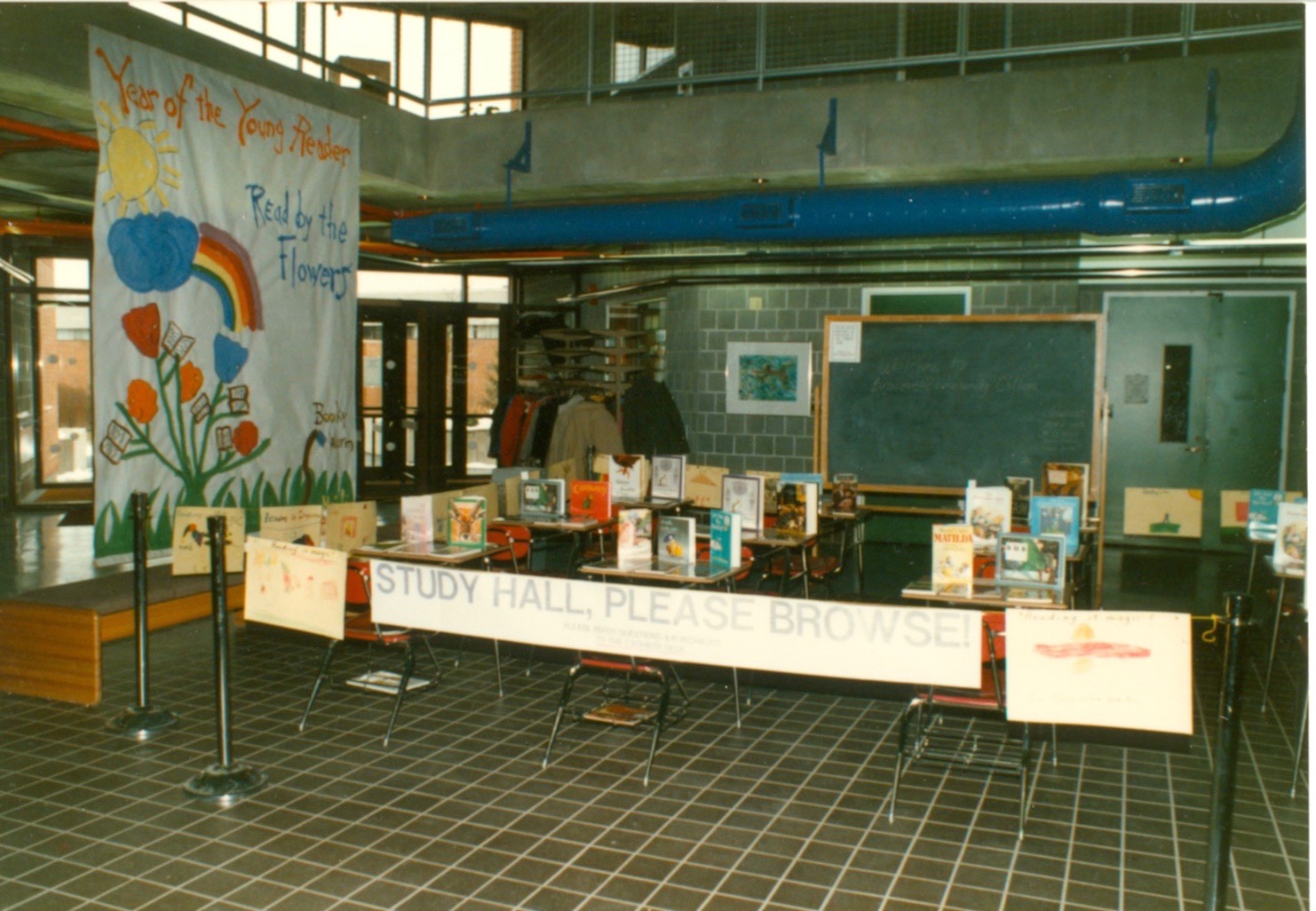
I have been into some of the DDD archives. Yikes! This is 1989 when I worked at the BCC Bookstore. The college hosted a childrens book conference for area teachers/librarians and I did the book display in the atrium of the science building. We did large tempera "reproductions" of kids' drawings for the big back drops.
Were any of you there?


Wednesday, November 15, 2017

The Hidden Life of Trees


It was a bit of a journey for this book to get to our shelves from when I first read about it a few years ago; waiting for it to be translated from German, not forgetting about it in the interim. I’m glad we persevered because it unveils the world around us with the same awe, intimacy, and reverence as Annie Dillard’s Pilgram at Tinker Creek, Bernd Heinrich’s Winter World, and the cogent observations of Wendell Berry. It is a call, once again, to be humbled as a species as our colleagues on the planet are revealed to us as equally glorious.

The Hidden Life of Trees by Peter Wohlleben surprises us with how much is known about the daily, seasonal, and lifetime commerce of being a tree, of being a forest. That the author shades his observations with allusions to the sensory and intellectual capacity of trees, does not diminish the sway of his data, the revelation of his syntheses, or the amazingness of our usually “back-drop” neighbors; trees.

It is difficult not to interrupt the other person in the room with new-found facts of the forest:

Forest trees support each other, the damaged and stricken, to maintain the sustaining biome of the forest – mutual care. Young trees, waiting 70 years under the sun-stricken canopy of a mature forest aren’t deprived – they are in  a “nursery,” often supplemented by decaying grandparents; slow growth and patience being the plan for when opportunity eventually knocks. Miles of fungal conduit in teaspoons of forest soil, onslaughts of silent infestations parried with chemical counterattacks (and prior notification to neighbors). Indeed, Wohlleben reminds us it much less a “delicate balance” in nature than one continuous siege between occupying forces.

Having read it now, I look at the trees in my yard, the clammer of saplings along the roadside, and my stand of hickory trees with renewed respect. The intricacies of this slow world of trees, with so much of the drama and dynamism happening in the opaque world beneath our feet, will not be easily dismissed as silent, unchanging, passive, or dull.

Monday, October 2, 2017

Hallway exhibit

Added a temporary exhibit of my Bumps Creek posters to our venerable library hallway mural.

Monday, September 11, 2017

Followed up

Followed up with a hallway poster and web site banner:

Friday, September 8, 2017

Everybody into the pool!

Each year, elementary students arrive to find their art room transformed into another world: a Gothic cathedral, an Aztec empire, and Egyptian tomb. This year Ms. Humphrey has sunk the room underwater for a unit where students will create fish to populate ... the pond! Amazing.

Friday, June 16, 2017

Two more

I have now created five Bumps Creek ecology posters, one for each of my end-caps, for back-to-school in the Fall. I'm hoping they will give me a running start on science and history posters for the school hallways.

Wednesday, May 24, 2017

Depth of learning

So I took the image of my StreamStats watershed delineation and made a Google earth overlay (.kmz, bottom of page) of it which reveals the terrain much better; aligning, very clearly, the perimeter of the basin with the crests of the surrounding landscape. #cooltool

Tuesday, May 23, 2017

Our Tuesday library look

Set up part of the library floor for possible small group break-outs in MS Science. Cornered the center tables with colored masking tape so we can quickly configure groups.

Monday, May 15, 2017

StreamStats: delineating watersheds

To continue from my last post, here is the output from StreamStats from the USGS. Once you click on a point in your stream it "delineates" the watershed that feeds that point! So here is the Bumps Creek watershed and a sampling of the accompanying characteristics: drain area = 7.6 sq. miles, elevation change = 64 feet per mile, length of elevation contour = 40.61 miles, etc.

Tuesday, November 15, 2016

Posters

I have been kicking out almost a poster per day since meeting with and encouraging the elementary faculty to share photos we might use to motivate students and enhance school climate. Just waiting on some safety clarification for them to be posted.

Tuesday, September 27, 2016

Re: my last post

With our entire high school population having laptops or notebooks, I am going to see if this fixture configuration might cultivate more active student-collaboration from classrooms.

So this morning I moved all my heavy wood (read 1980s) tables and chairs into the former LibLab (I kept all the cool custom-painted chairs!), and hauled out the lab chairs and tables into the Library proper. These table are 27" high (better for keyboarding than the old 29" tables), and they are easier to move and configure into collaborative arrangements. They also have cable ports so that I can install our charger stations.
I'm working with Tech Support to get the functionality of our mobile Smartboard operating for an interactive group station.
I have our comfy chairs and painted chairs in suggested learning pod-type arrangements. Moving chairs and tables will be encouraged (I plan to make table-top signs.).
These changes will support our collaboration station (monitor connectivity), green screen studio, and laptop counter.

I hope these changes won't just accommodate the users, I hope they will inspire our teachers to design collaborative student projects, embrace the try/fail/learn-from-each-other-process, and leverage the opportunity to "extend their classroom."


Wednesday, May 11, 2016

Ecology food web

Having a blast with 7th grade science. They are observing a living organism around their house, researching its identity, then constructing a food web. It's about recognizing that you are somewhere in the world, and noticing it.
My sample

That said, I organized the milieu of resource books on my tabletop into domains to make them easier to locate.

Monday, March 21, 2016

The freedom of a square

The April 7th issue of the New York Review of Books has an article by Michael Kimmelman entitled, " The Craving for Public Squares." It is one of those insightful two-pagers by someone who both notices the world and writes well enough to link us to it. It is part meditation on the subject and part historical perspective. He had me when he wrote,
Squares reaffirm our commonality, our shared sense of place, and our desire to be included. "It's why we congregate near the kitchen at a dinner party instead of the living room," is how Andy Wiley-Schwatrz, who directed the plaza program during the Bloomberg administration, described to me the attraction of the square. "That's where you see people coming and going to the fridge to grab a beer and watch stuff happen.


Thursday, January 7, 2016

Keeping up with old school stuff


I've been reading Tony Wagner's The Global Achievement Gap, a loan from a colleague. That prompted me to thumb back through Ratzer & Jaeger's Toolkit for Implementing Inquiry Learning. Both of them helped me enjoy the thrum of unearthing and then posting a 1997 Art/Library ten-week project I did with 8th graders: Winter Night.

Those ten-week projects entailed 1) brainstorming & visualizing content ideas for our group project, then deciding how to decide which one to do, 2) identifying and placing on a time-line the research and presentation tasks we assigned ourselves for pulling it off,  3) doing the research (often letter-writing, interviews, guest experts, experiments, and 4) compiling what we found out and presenting it effectively to parents and invited guests at an after school event; in this case: Winter Night.

These Art/Library projects were wonderfully student-directed with room for individual interest to take hold and blossom. After the first 2 or 3 weeks, the library was truly a many-stationed workshop. My job was the "what if" guy, the attention to detail guy ("if you use a ruler you can be sure that is centered"), and the recap and "try it" guy.

Here are some artifacts of those weeks; facets of our Winter Night:

These student astronomers studied the Winter sky to construct a wall-sized chart of constellations. (Love the dot-matrix print job!)
Our naturalists contacted area vendors with SASEs and graphed birdseed sales to get a handle on the scope of that market.
This group contacted area residents for their recollections of memorable Winter storms; corroborating those memories with snowfall data at Link Field in Binghamton.
Our snowboarding crew designed small boards of various surfaces, time-tested them on a ramp of their own design, graphed results, and drew conclusions.

While our meteorologist made daily photo documentation as well as temperature, humidity, and barometer readings to try their hand at forecasting.

Inquiring, researching, writing, interviewing, selecting appropriate tools, problem-solving, critical thinking, craftsmanship, data collection and visualization, community resources, celebrated accomplishments.